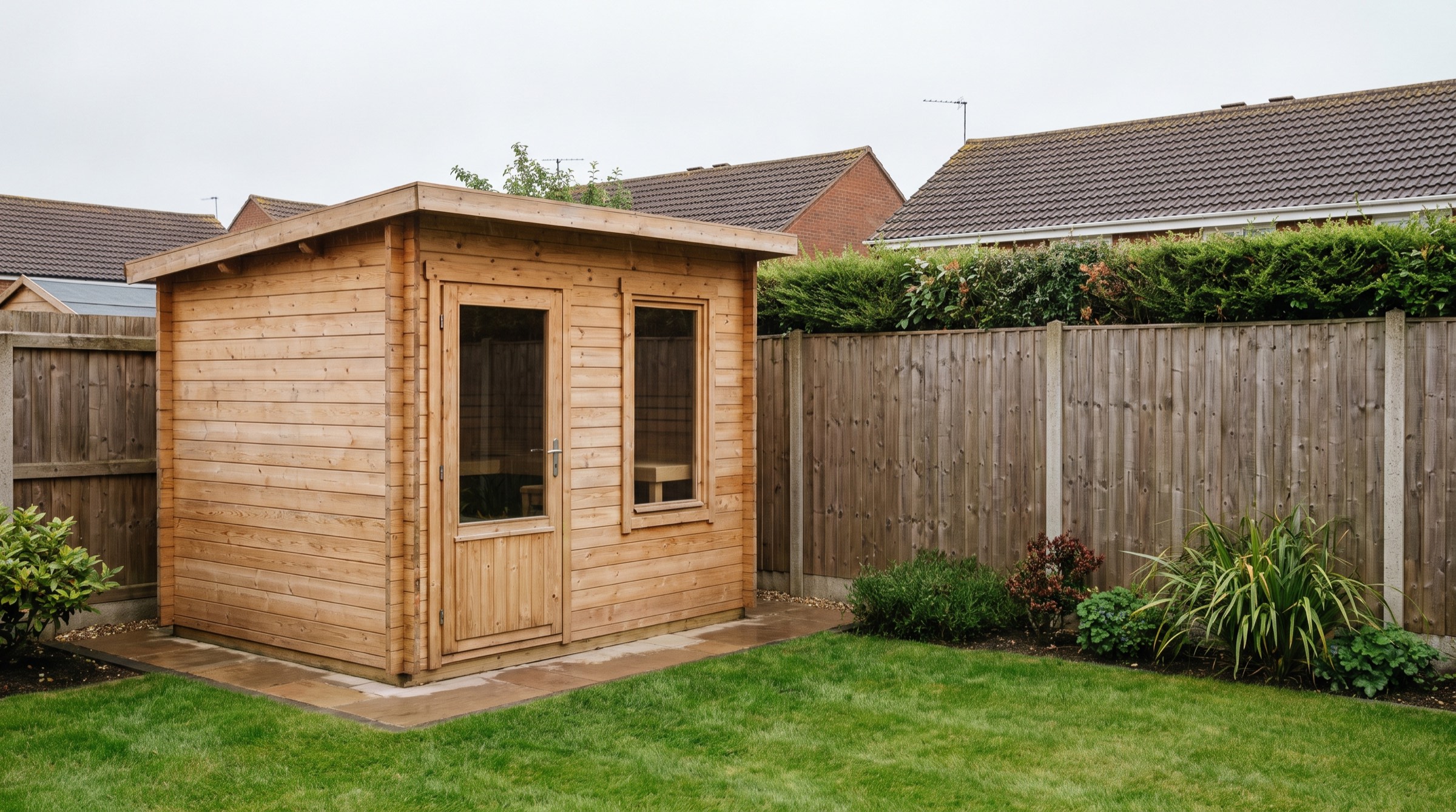
For most outdoor saunas in England, the answer is no — you don’t need planning permission. The cabin falls within permitted development rights for outbuildings. The exceptions are real, but specific.
That’s the short version. The longer version is worth ten minutes of your time before you order, because the categories of exception (listed buildings, conservation areas, Article 4 directions, wood-fired flues) catch a meaningful slice of UK properties and they’re cheaper to spot now than after delivery. We’ve heard from enough readers who got caught by one of these to know it’s worth being thorough.
This guide covers the UK position in May 2026, with the caveat that planning rules occasionally change and local councils have discretion within the framework. If your situation is borderline, the £103 you’ll spend on a Lawful Development Certificate is the best money you’ll spend on the whole project.
Permitted development — what England actually allows
An outbuilding (including a sauna cabin) falls within permitted development if it meets the standard tests in Schedule 2, Part 1, Class E of the General Permitted Development Order. In plain English, that means:
- Single storey. Two-storey saunas don’t exist, so this one’s easy.
- Eaves height no more than 2.5m if any part of the cabin is within 2m of a boundary.
- Maximum total height: 4m for a dual-pitched roof, 3m for any other roof, or 2.5m if within 2m of a boundary.
- Less than 50% of the total garden covered by outbuildings, cumulatively (so the existing shed counts towards your budget).
- Not forward of the principal elevation of your house. Front gardens are out unless you apply for full planning.
- No verandahs, balconies or raised platforms above 0.3m.
- It must be incidental to the enjoyment of the dwelling — which a sauna obviously is. You can’t build a holiday let under this route.
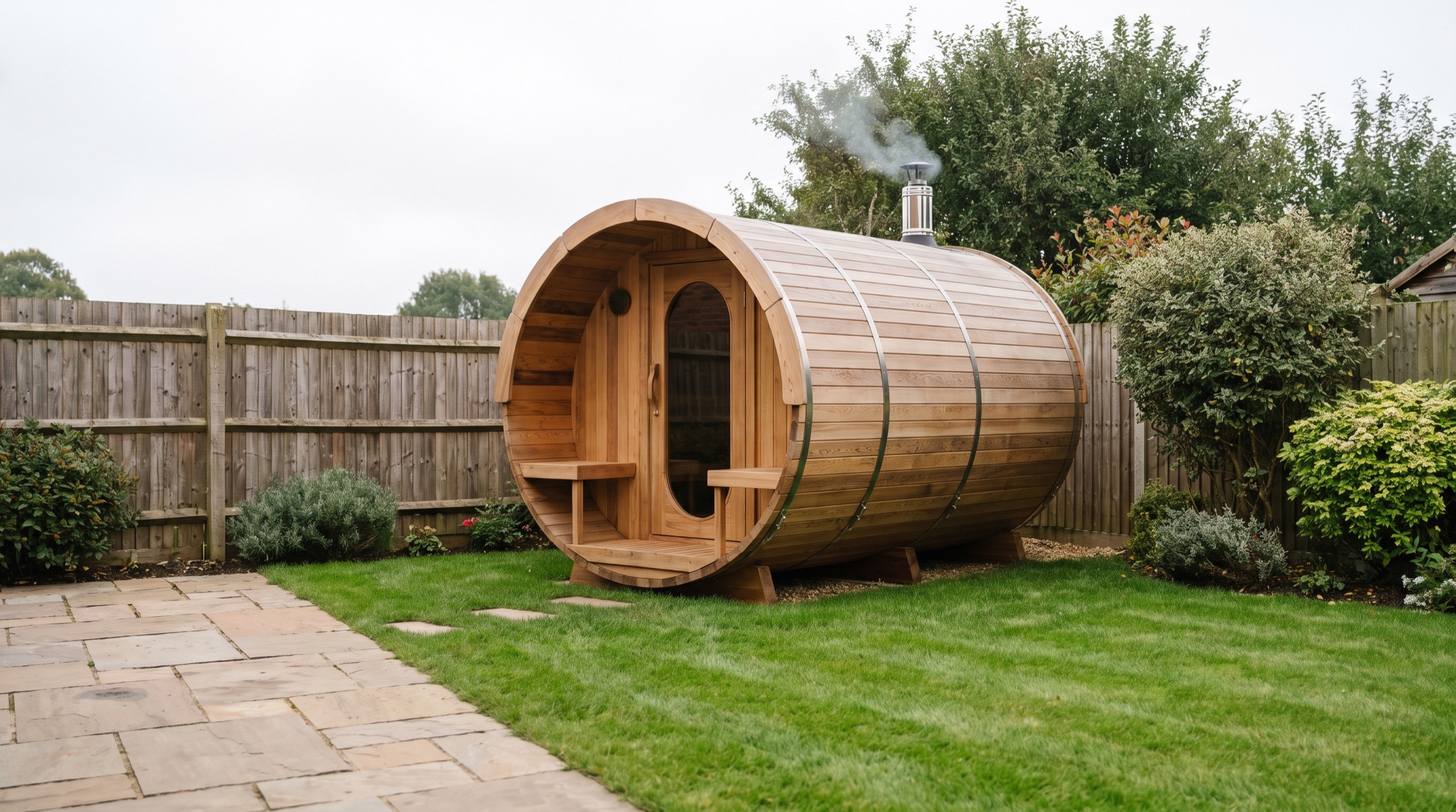
For barrel saunas, sauna pods, and most cabin-style outdoor saunas under 3m tall, sited in the back garden, with a boundary clearance of at least 2m where the eaves are higher than 2.5m, this works without an application. That’s why most people don’t need to do anything.
If any one of those tests fails, you need either a full planning application or a Householder application. We’ll come back to that.
When you do need planning permission
There are six common situations where permitted development doesn’t apply, regardless of the cabin specs.
Listed buildings
If your house is listed (Grade I, Grade II*, or Grade II), permitted development is removed. You need listed building consent for any alteration that affects the character of the building or its setting — and a freestanding sauna in the garden often qualifies. Listed building consent is a separate, more involved application than ordinary planning permission, and works without it are a criminal offence under the Planning (Listed Buildings and Conservation Areas) Act 1990.
If you don’t know whether your house is listed, check the Historic England List by address. It takes thirty seconds.
Conservation areas
Conservation areas have partial restrictions on permitted development — usually around design, materials, and visibility from the street. A sauna at the bottom of the garden, screened by an existing fence, often goes through fine. A glass-fronted pod visible from the conservation-area street might not.
Our practical advice: ring the planning department of your council before you order. A short, polite conversation with the conservation officer is free, takes ten minutes, and will save you significant grief later. Be specific — give them the dimensions, the cladding material, and a rough siting plan. Most are surprisingly helpful when you ask up front.
Article 4 directions
An Article 4 direction is a localised order that removes specific permitted development rights on specific streets or estates — often to preserve a particular character or to stop garden buildings overshadowing neighbours. They’re invisible unless you look for them.
Check whether your property has an Article 4 direction on your council’s planning portal. Search the address, or look at the policy maps. If you’re in any kind of designated area (a Garden Suburb, a model village, a heritage estate), the chance is non-trivial.
Designated land
Properties in National Parks, Areas of Outstanding Natural Beauty (AONBs), the Norfolk and Suffolk Broads, World Heritage Sites, or designated Conservation Areas have stricter permitted development limits. The total floor area of all outbuildings within the curtilage is capped at 10 square metres in some designations — small enough that even a 2m × 2m sauna eats into the allowance.
If you’re in any of these designations, get specific local advice. The framework is consistent nationally; the application is local.
Cabin too large
The 4m / 3m / 2.5m height limits matter. A 3.2m-tall pod sited 1.5m from your boundary fails the 2.5m boundary-clearance limit and needs planning permission. So does any cabin that pushes you over 50% garden coverage.
This is the most common failure point we see. Read the spec sheet from your supplier carefully. The “external height” figure on the brochure is the one that matters — not the internal ceiling height.
Forward of the principal elevation
Front-garden saunas always need planning permission. Even if the cabin would otherwise pass every test, siting it in front of the line of your front wall removes permitted development. We’re including this for completeness — we’ve never met anyone who actually wanted a front-garden sauna — but the rule exists.
Wood-fired saunas — the flue rules
Wood-fired saunas have an extra layer of regulation on top of planning. The flue must comply with Building Regulations Part J (combustion appliances and fuel storage), and in some areas the stove itself is restricted.
Flue height and proximity to openings
The flue terminal must be at least 2.3m above any opening (window, door, vent) within 2.3m horizontally on neighbouring buildings, and similar distances apply to roof-level openings. The exact distances are in Approved Document J. A flue that vents straight at a neighbour’s bedroom window is going to cause problems, whether or not the planning rules apply.
Smoke control areas
Most UK cities and many towns are designated smoke control areas under the Clean Air Act. Inside a smoke control area you can’t burn unauthorised solid fuels and you can only use a DEFRA-exempt stove. The list of exempt appliances is on the DEFRA Smoke Control register — check your sauna stove model is on it before you order, if you’re inside a smoke control area.
If you’re outside a smoke control area, the rules are softer but the neighbour considerations don’t go away. Smoke from a wood-fired sauna doesn’t smell like a wood-burning stove smells in your living room — it’s the same chimney with much shorter, hotter cycles. Site it thoughtfully.
Wales, Scotland and Northern Ireland
The rules are similar in shape but different in detail.
| Nation | Position for outdoor saunas |
|---|---|
| England | Permitted development if it meets the Class E tests above (height, boundary, 50% garden, behind the front elevation). |
| Wales | Broadly the same framework as England, with minor differences in height limits and conservation-area treatment. See the Welsh Government planning portal. |
| Scotland | Outbuildings under 8m³ usually fall within permitted development; larger ones need a Householder application. Most outdoor saunas exceed 8m³. |
| Northern Ireland | Most restrictive — standalone outbuildings often need an application unless under 4m² in footprint. Check your local Planning Service. |
How to check before you order
A five-minute desk check before you press buy will save you weeks of grief if something’s off. Our recommended sequence:
- Pull up your council’s planning map. Most are searchable by address through the council website. Check whether your property is in a conservation area, has Article 4, is listed, or is on designated land.
- Search Historic England’s list by address to confirm the listing status.
- Read the cabin spec sheet from your supplier. Check the external height, the footprint, and the boundary-clearance requirement.
- Measure your garden boundary clearances. The 2m boundary rule is the one that catches people; the height limit drops from 4m to 2.5m if any part of the cabin sits within 2m of a boundary.
- If anything looks borderline, call the planning department. A short polite call before you’ve committed to a cabin is dramatically more pleasant than the conversation you have if enforcement gets involved later.
- For a definitive answer, apply for a Lawful Development Certificate (LDC). This is the gov.uk-standard “certificate of lawfulness” application — it confirms in writing that what you’re proposing is permitted development. The fee in England is around £103 (half the usual planning fee), it takes 4–8 weeks, and the council can’t change their mind once issued. It’s also useful evidence at sale time.
Most UK sauna builders we’ve worked with know the local position in their patch better than the council does. If you’re using a builder from our directory, ask them to flag the planning angle for you as part of the initial quote. Most do.
Building Regulations vs planning permission
These two are often confused — they’re different approvals.
- Planning permission is permission to put the building there. It’s about land use, visual impact and neighbour amenity. Granted (or denied) by your local planning authority.
- Building Regulations are about how it’s built — structural soundness, fire safety, electrical safety, ventilation, energy efficiency. Even if no planning permission is needed, the electrical work for a sauna is notifiable under Part P of the Building Regulations, and must be carried out and signed off by a competent person (usually a Part P-registered electrician).
You often need to think about both. They run in parallel — getting planning permission doesn’t waive Building Regs and vice versa.
What happens if you skip it
The enforcement risk is real but proportionate. Local authorities don’t drive around looking for unauthorised garden saunas. They respond to complaints — typically from a neighbour — and to issues that come up during a property sale.
If enforcement is triggered, the usual outcome is a request to apply retrospectively. If retrospective permission is granted, life carries on. If it’s refused, the council can issue an enforcement notice requiring removal. The 2024 Levelling-Up and Regeneration Act changed the time limits — most unauthorised building work now has a 10-year immunity period (it used to be 4 for building, 10 for change of use). After that, it can’t be enforced.
The practical issue is selling your house. Conveyancing solicitors ask about every visible structure, and “we didn’t get planning for the sauna” is the kind of question that holds up an exchange. Indemnity insurance is the common workaround (around £150–£400 for a policy that covers planning enforcement risk), but it’s cleaner to do it properly the first time. The £103 LDC is much cheaper than the indemnity premium.
Frequently asked questions
Can I put a sauna in my front garden without planning permission?
No. Anything forward of the principal elevation of the house always needs planning permission, regardless of size or design. The vast majority of front-garden sauna applications get refused on amenity grounds.
Does a barrel sauna count as a permanent structure?
For planning purposes, yes — if it’s sited there for more than 28 days. The “incidental to enjoyment of the dwelling” test covers any structure intended to stay. Whether the cabin is sitting on a concrete slab, paver pads, or just on bearers makes no difference to the planning position.
Do I need planning permission for a sauna under 2.5m tall?
Usually not, providing you also pass the 50%-garden, behind-the-principal-elevation, and “no verandahs” tests. The 2.5m figure is the strict eaves-height limit if any part of the cabin sits within 2m of a boundary; below 2m boundary clearance and 2.5m eaves, you’re inside permitted development.
Can my neighbour object to my outdoor sauna?
If permitted development applies, no — there’s no planning process for them to object to. They can complain to environmental health about noise, smoke (wood-fired), or light, and those are separate frameworks. If a full planning application is needed, neighbours can comment during the consultation period and the planning officer takes that into account.
What’s the difference between Building Regs and planning permission?
Planning permission is about whether you’re allowed to put the building there. Building Regs are about how it’s built — structural safety, electrical safety, ventilation, fire. The electrical work for a sauna heater is notifiable under Part P regardless of whether planning is needed. Most installs need attention to both.
The bottom line
For a typical UK back garden, a typical outdoor sauna doesn’t need planning permission. The exceptions catch a meaningful minority of properties — particularly listed buildings, conservation-area properties, and homes inside designated land — and the wood-fired flue rules add a layer on top. Five minutes of checking before you order is the right investment of time. A £103 Lawful Development Certificate, in the borderline cases, is the right investment of money.
If you’d like a builder who’s handled the planning angle for clients in your area before, browse our UK builder directory and filter by region. Most listed installers will check the local position for you as part of the quote — saving you the call to the council.
Planning is just one piece of the picture — see the full budget in our guide to how much a sauna costs in the UK, or browse all our installation & planning guides.
Reviewed by the SaunaCentral editorial team. This guide reflects UK planning rules as of May 2026 and is for general information only — for a definitive answer on your specific property, contact your local planning authority or apply for a Lawful Development Certificate. Spot something out of date? Tell us — we’ll update it.
Looking for a sauna recommendation?
Tell us your space, budget, and preferences. We’ll match you with the perfect sauna from our curated selection.