
By Matt Tomkin, Editor, SaunaCentral — updated 27 July 2026.
In short: A home sauna is a sauna installed inside the house — most often in a bathroom, basement, garage conversion or spare room. A pre-built freestanding cabin costs £2,500–£8,000; a custom room sauna built into the space runs £4,000–£15,000. Two things make or break an indoor install: proper ventilation and a vapour barrier behind the wall lining. The electrical work is notifiable under Part P of the UK building regulations.
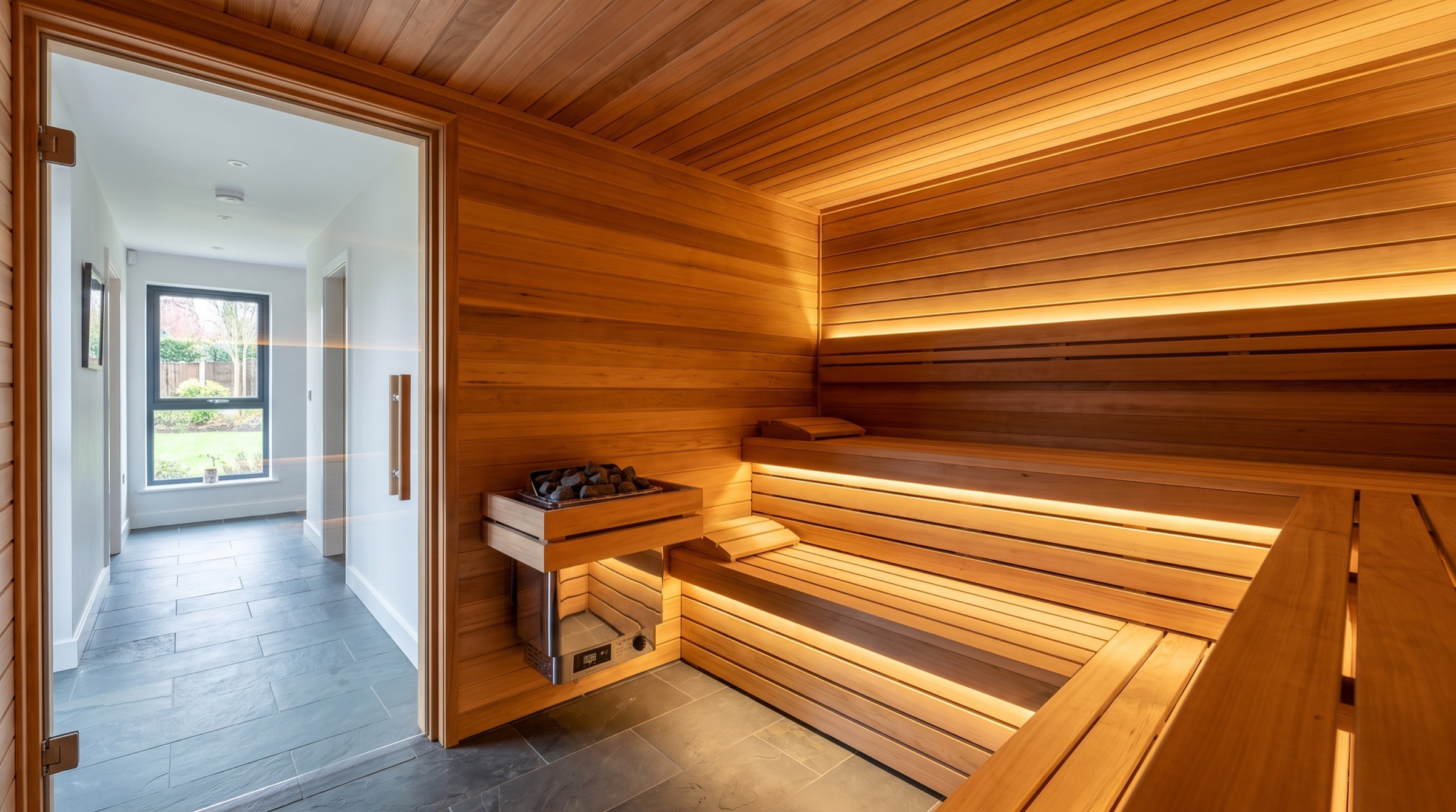
An indoor home sauna is the more convenient version of the experience. Five paces from the shower to the heat, no walking across a wet garden in January, no concrete pad to lay. The trade-off is up-front complexity: indoor saunas need proper ventilation, the right floor, and (for most installs) a Part P-certified electrician. Done well, they’re a permanent and high-value addition to the house. Done badly, they create moisture problems that show up two years later.
This guide is for UK homeowners considering an indoor sauna in a bathroom, basement, loft, garage conversion, or dedicated room.
Where to put it
Most UK indoor saunas go in one of four places: a bathroom, a basement, a garage conversion, or a loft or spare room. Each trades convenience against footprint and moisture risk.
| Location | Best for | Watch out for |
|---|---|---|
| Bathroom (en-suite or family) | Retrofits — closest to existing plumbing and ventilation | Most bathrooms are too small for a 2m×2m sauna without losing the bath or shower |
| Basement / cellar | Sound and heat insulation; often the right footprint | Damp — UK basements need careful waterproofing first |
| Garage conversion | Good footprint, easier to run a 32A circuit from the consumer unit, and it makes the garage useful again — one of the most common indoor locations UK installers work on | The conversion itself is usually the bulk of the cost |
| Loft / spare room | Dry installs where floor loading is adequate | Getting the unit up the stairs — pre-built cabins rarely come apart again, so check the route in advance |
Indoor sauna types
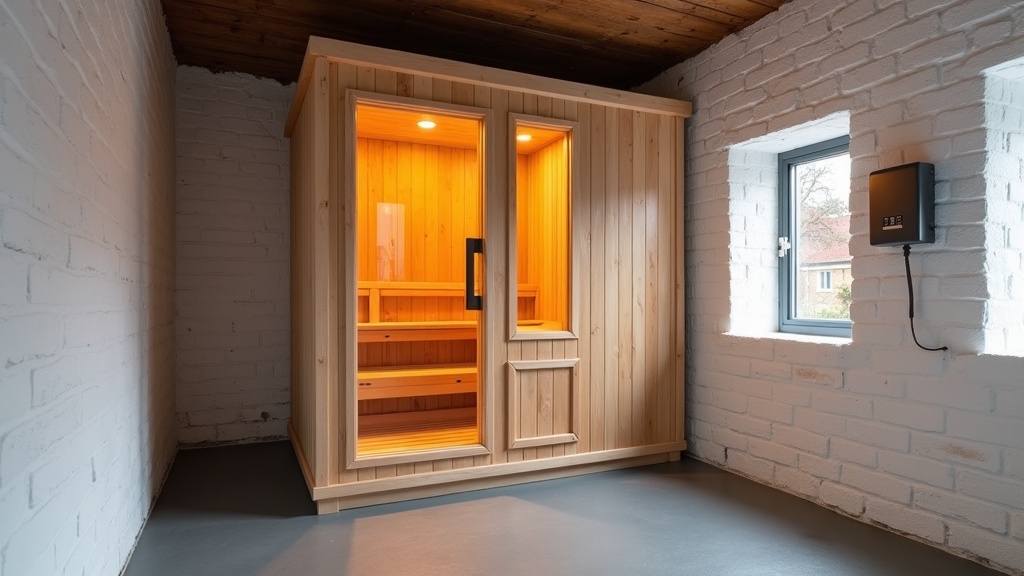
There are three ways to put a sauna inside a UK home: drop in a pre-built cabin, build one into the room, or fit a low-temperature infrared cabin.
| Type | Typical size | Price | Install effort |
|---|---|---|---|
| Pre-built freestanding cabin | 1.5m × 1.5m to 2m × 2m | £2,500–£8,000 | Easiest — move it in and connect the electrics |
| Custom-built room sauna | Built to the room | £4,000–£15,000 | Most work, but far better use of awkward spaces |
| Infrared cabin | 1 to 3 person | £1,500–£5,000 | Simplest — no ventilation needed, runs on a standard 13A socket |
A custom room sauna gets you wall-to-wall benches and integrated heating; a UK builder can quote for one. For the lower-temperature option, see infrared saunas.
Ventilation
Ventilation is the single most important detail in an indoor sauna install — get it wrong and you get damp, not just poor heat. Air must be able to enter the cabin (low intake, near the heater) and exit (high outlet, on the opposite wall) so the heat circulates and so moisture doesn’t build up in the surrounding room.
For a freestanding unit in a well-ventilated existing room, the cabin’s own vents are usually enough. For a built-in sauna in a bathroom or basement, plan an extractor that vents to outside — not just into the loft or roof space, which moves the moisture problem rather than solving it. Part F of the building regulations applies to ventilation in habitable rooms.
Flooring
An indoor sauna floor needs to be waterproof and slip-resistant — tile on a tanked screed is the default choice in UK homes. The acceptable options:
- Tile on a tanked screed with a drain. Most common in bathrooms and dedicated rooms. Slip-resistant porcelain is the safe choice.
- Sealed concrete in a basement or garage conversion. Cheap and indestructible.
- Treated hardwood in upstairs/dry installs. Less ideal — needs annual sealing.
Carpet under a sauna is a no. Standard laminate is a no. Engineered wood is a maybe, with a vapour-proof underlay.
Electrical work
A 6kW indoor sauna heater needs a dedicated 32A radial circuit. Larger heaters (8–9kW) need 40A. The work is notifiable under Part P of the UK building regulations and must be done by a competent person. Budget £350–£900 for the electrical work in a typical UK home where the consumer unit isn’t on the other side of the house. Our installation hub has the detailed checklist.
Drainage and damp
Indoor saunas put moisture into the surrounding room. Three things to plan for:
- A floor drain if you’re going to wet down the rocks or rinse the cabin. Otherwise, a tray or duckboard handles the small amount of run-off.
- Adequate ventilation (see above) so moisture doesn’t sit in the wall void.
- Vapour barrier behind the wall lining — a foil-faced membrane between the cabin walls and the structural wall behind. Crucial. Most pre-built cabins include this; custom builds need it specified.
Realistic UK budgets
All-in costs for a home sauna in the UK in 2026, including the unit, electrics and associated building work.
| Scenario | Typical all-in cost | What that covers |
|---|---|---|
| Pre-built freestanding cabin in an existing room with sockets | £3,000–£7,500 | Unit, electrics and minor floor work |
| Built-in sauna as part of a bathroom refit | £6,000–£15,000 | Sauna build, ventilation, tanked floor and drainage |
| Basement sauna in an existing waterproofed basement | £5,000–£12,000 | Sauna build and electrics; assumes waterproofing is already done |
| Garage conversion including the sauna | £15,000–£35,000 | Most of this is the garage conversion itself, not the sauna |
Recommended home saunas
Our 2026 picks are in the buying guides hub. Until our affiliate partnerships are confirmed, links route to the parent guides.
Frequently asked questions
Will an indoor sauna damage my house?
Not if it’s installed properly. The risk is moisture, not heat. Get the ventilation and vapour barrier right and there’s no issue. Get them wrong and you’ve got a damp problem in 2–3 years.
Do I need planning permission for an indoor sauna?
No — internal alterations don’t typically need planning permission. You may need building control sign-off for the electrical work (Part P) and any structural changes.
Does an indoor sauna add value to my house?
A well-installed home sauna is broadly positive for resale value in the right kind of house. A badly installed one is negative — buyers can see moisture damage or worry about it. The honest answer: it adds the most value when the install is high-quality and the location makes sense in the floorplan.
Indoor or outdoor — which is better?
Indoor wins on convenience. Outdoor wins on experience (the cold-air contrast is half the point) and on installation cost. Our comparisons hub has a dedicated article.
About the author
Matt Tomkin is the editor of SaunaCentral, an independent UK guide to home and garden saunas. SaunaCentral doesn’t sell saunas — we research the whole UK market, talk to installers, and connect buyers with vetted builders through our builder directory. Costs on this page are based on 2026 UK retail and installation prices, and the regulatory guidance follows the current Approved Documents for Part P (electrical safety) and Part F (ventilation).
Related categories
- Infrared Saunas — the low-temperature indoor option
- Outdoor Saunas — the alternative if you have garden space
- Barrel Saunas — the cheapest outdoor shape
- Garden Saunas — cabin-style garden builds
- Sauna Pods — compact self-contained units
Want a UK installer for a built-in home sauna? Browse our directory — most of our listed builders take on indoor installations.