
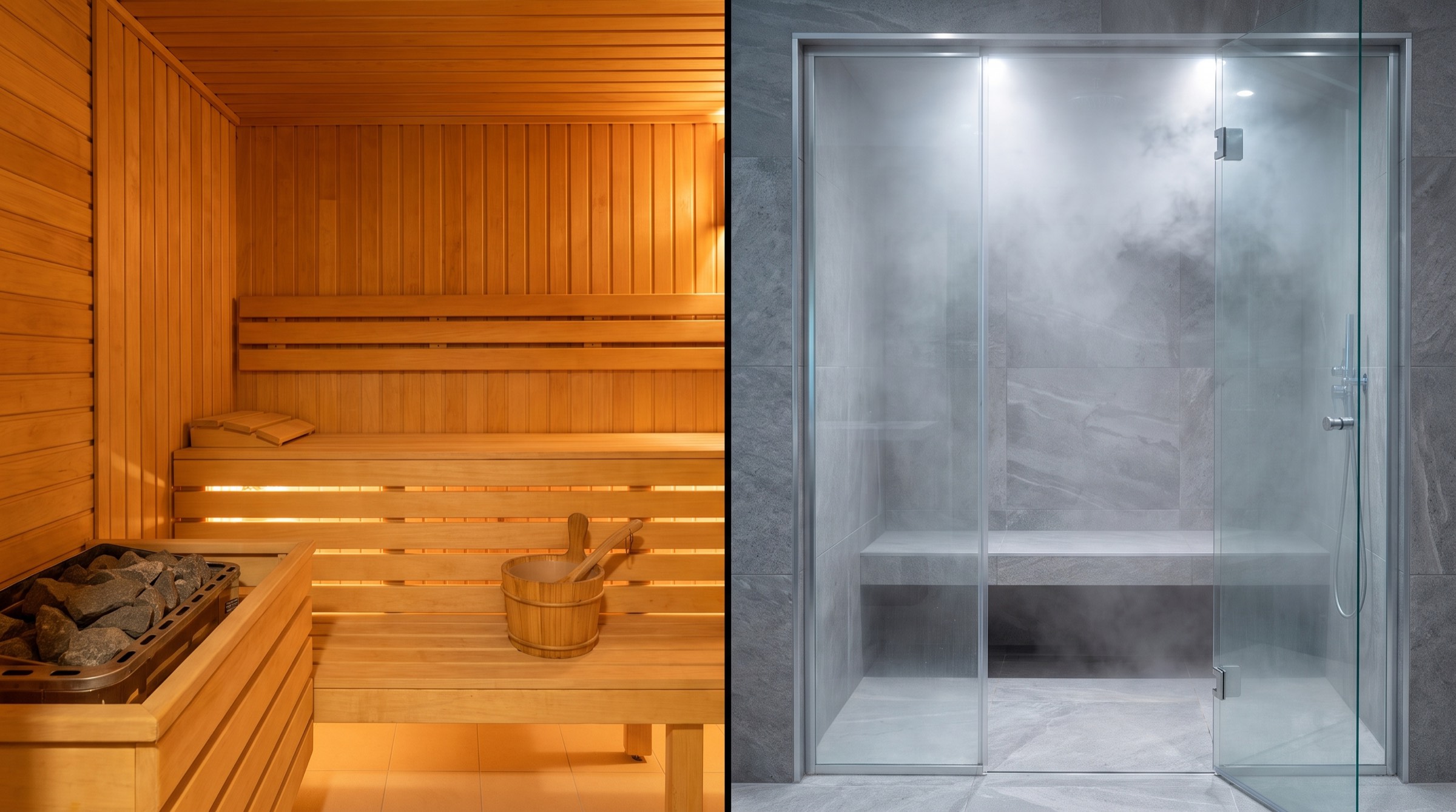
If you’re picking between a sauna and a steam room for the back of a UK house, the answer is almost always a sauna. The reason isn’t really health. It’s installation.
Steam rooms work brilliantly in fully tiled, sealed, mechanically vented bathrooms. They struggle in damp British gardens, and they’re a pig to retrofit into a house that wasn’t designed for them. Saunas don’t mind either way — outdoors, indoors, garage conversion, basement, all fine.
That said, the question gets asked for good reasons. The two appliances work on completely different physics, and the health claims around them have very different levels of evidence behind them. This is the head-to-head we wish someone had written for us. We cover what actually differs, what the research properly supports, and roughly what each one costs to put in and run in the UK in 2026.
A note from the editor: when we ran our reader survey at the start of the year, around three quarters of the people emailing us about steam rooms turned out to be after a humid feel inside an existing bathroom — not a separate sealed room with a generator. If that’s you, you’re probably looking for a body dryer, a steam shower head, or an upgraded extractor — not a full steam room. We’ll come back to that towards the end.
Sauna vs steam room: the quick comparison
| Traditional sauna | Steam room | |
|---|---|---|
| Heat type | Dry heat | Wet heat (saturated steam) |
| Temperature | 60–95°C | 40–50°C |
| Humidity | 10–20% | 100% |
| Typical session | 10–20 minutes | 20–30 minutes |
| Cardiovascular evidence | Strong — 20-year cohort data | Limited — small studies only |
| Respiratory comfort | Dry air, can irritate | Humid, eases congestion |
| Skin | Can dry the skin | Kinder to the skin barrier |
| Who should be cautious | Pregnancy, heart or lung conditions, or medication affected by heat: the NHS lists these groups as most at risk. Ask your GP first. | The same groups. Saturated air stops sweat evaporating, so core temperature still climbs even at 40–50°C. |
| Where it installs (UK) | Outdoor, indoor, garage or basement | Sealed indoor bathroom only |
| Typical install cost | £3,000–£15,000 | £4,000–£10,000 (steam side, plus the bathroom) |
| Running cost per session | ~£1.20–1.40 | ~£0.60–1.20 |
| Maintenance & lifespan | Low; 15–25 years | Higher; seals fail at 5–8 years |
| Best for | Cardio, sociable use, gardens | Respiratory relief, bathroom refits |
Each of those rows is unpacked below.
How each one actually works
A traditional sauna sits at 60–95°C with 10–20% humidity. The heat is dry. If you pour water onto the rocks (the Finnish call this löyly) you get a burst of damp heat for thirty seconds before the cabin returns to dry. The body’s response is rapid sweat and an elevated heart rate. Sessions are short — 10 to 20 minutes for most people, with cool-down breaks.
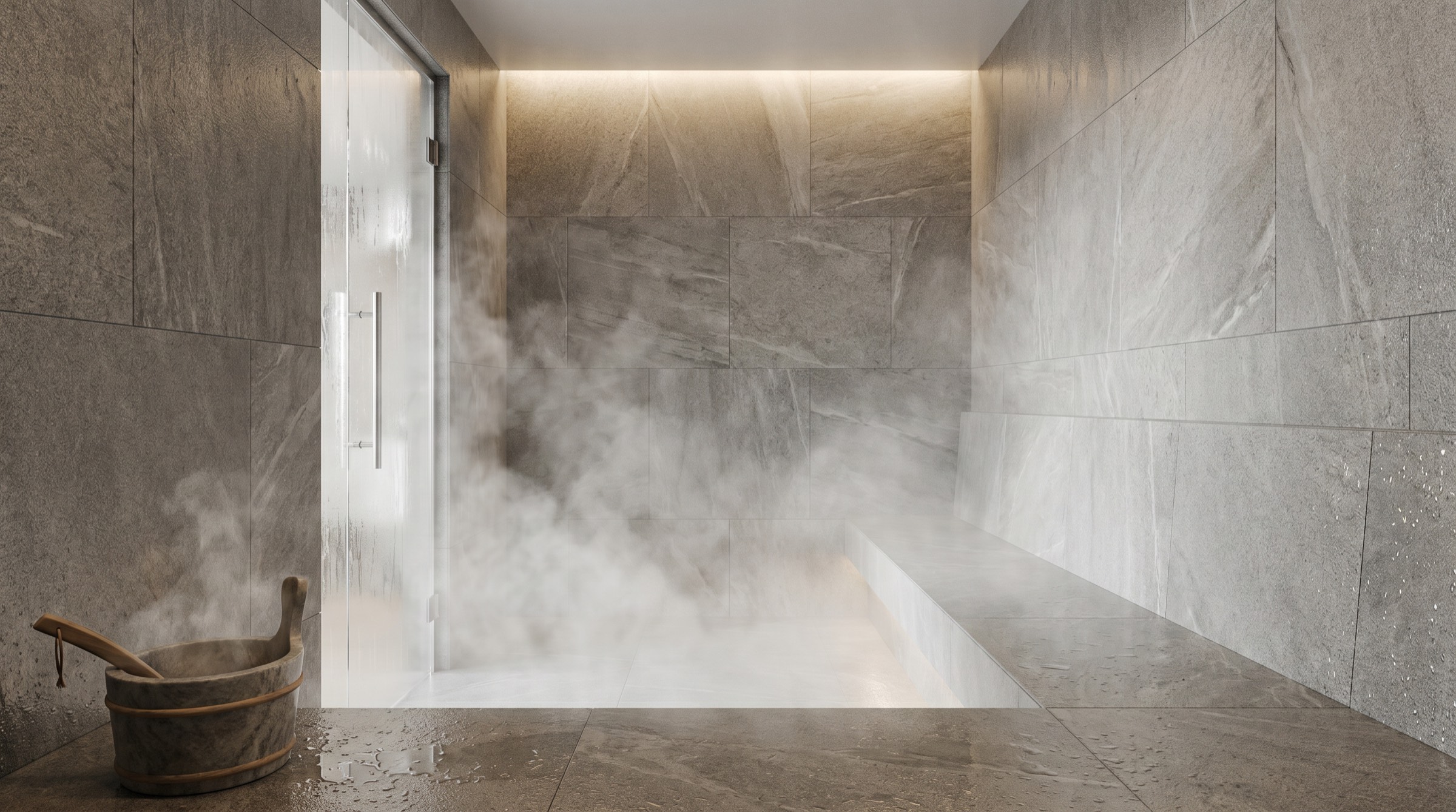
A steam room sits at 40–50°C with 100% humidity. The air is saturated. Sweat doesn’t evaporate the way it does in dry heat, so you stay covered in moisture rather than feeling parched. The temperature is much lower than a sauna, but the perceived intensity can be similar because the body can’t shed heat as effectively. Sessions tend to be longer — 20 to 30 minutes for most people.
An infrared sauna is a third option that sometimes gets lumped into this conversation. It uses infrared panels to warm the body directly rather than heating the air, runs at 45–65°C, and has a different evidence base again. We’ve written about it separately in our infrared saunas guide — for the purposes of this article we’re comparing traditional sauna against steam room.
Health benefits — what the research actually supports
We’ll be plain about this section. The cardiovascular evidence for traditional sauna use is much stronger than the cardiovascular evidence for steam rooms. That isn’t because steam rooms are bad — it’s because they haven’t been studied to anything like the same standard.
Cardiovascular
The best-known sauna data is the Kuopio cohort: a Finnish study published in JAMA Internal Medicine in 2015 that followed 2,315 middle-aged men for 20+ years. Four to seven sauna sessions a week was associated with a 50% lower risk of sudden cardiac death versus once-weekly use. That’s an enormous effect for any lifestyle intervention, and the Kuopio team has published a string of follow-ups since on hypertension, dementia and all-cause mortality, with broadly similar associations.
It’s an observational study — you can’t conclude causality from it alone, and the cohort was Finnish men, not UK women. But the effect size is large, the dose response is consistent, and the proposed mechanisms (improved vascular function, heat-shock proteins, an exercise-like cardiovascular load) all check out at the bench. Most cardiologists we’ve spoken to take the data seriously. We go deeper into the evidence in our guide to what sauna benefits the science actually supports.
For steam rooms, the equivalent body of research barely exists. There are a handful of small studies showing acute effects on blood pressure and heart rate, but nothing close to a 20-year cohort. If your motivation is cardiovascular, the sauna is the safer bet.
Respiratory
This is where steam rooms have an edge — at least anecdotally. Warm, humid air can ease congestion, loosen mucus, and feel kinder to anyone with asthma or chronic dry-air irritation. The NHS specifically recommends humid environments as part of managing acute bronchitis at home. The British Thoracic Society’s guidance on asthma management mentions warm humid air as a potentially helpful trigger-avoidance environment for some patients.
Saunas, by contrast, dry the airways. Most regular sauna users find this is fine or even pleasant. People with severe asthma sometimes find it irritating.
If respiratory benefit is your headline reason, the steam room argument is real. The honest caveat is that the research is still thinner than the marketing suggests.
Recovery from exercise
Both produce a measurable post-exercise recovery effect. Most of the studies we’ve read use sauna rather than steam, partly because sauna is easier to standardise (consistent temperature is easier to deliver). The effect sizes are modest in both cases — useful, not transformative. Sauna blankets fall in roughly the same range for solo recovery.
Skin
Steam room wins here. Saturated humidity is good for the skin barrier. Saunas can dry the skin out if you go in undermoisturised, although a sensible cool shower and a cup of water after a session sorts that out.
The detox claim
You’ll see both saunas and steam rooms marketed as “detox” tools. We’re skeptical of the framing. Your liver and kidneys do the heavy lifting on toxins; sweat is mostly water with a small amount of urea and sodium. The trace amounts of metals that come out in heavy sweating are real but tiny. Don’t buy either appliance for detox. Buy them for cardiovascular health, recovery, mental wellbeing, or because you enjoy them. All those reasons are stronger than detox.
UK installation — what each one actually costs
Saunas are dramatically easier and cheaper to install in the UK than steam rooms. This is the part of the comparison that decides the answer for most readers. For the full numbers, see our guide to how much a sauna costs in the UK.
Sauna installation in the UK
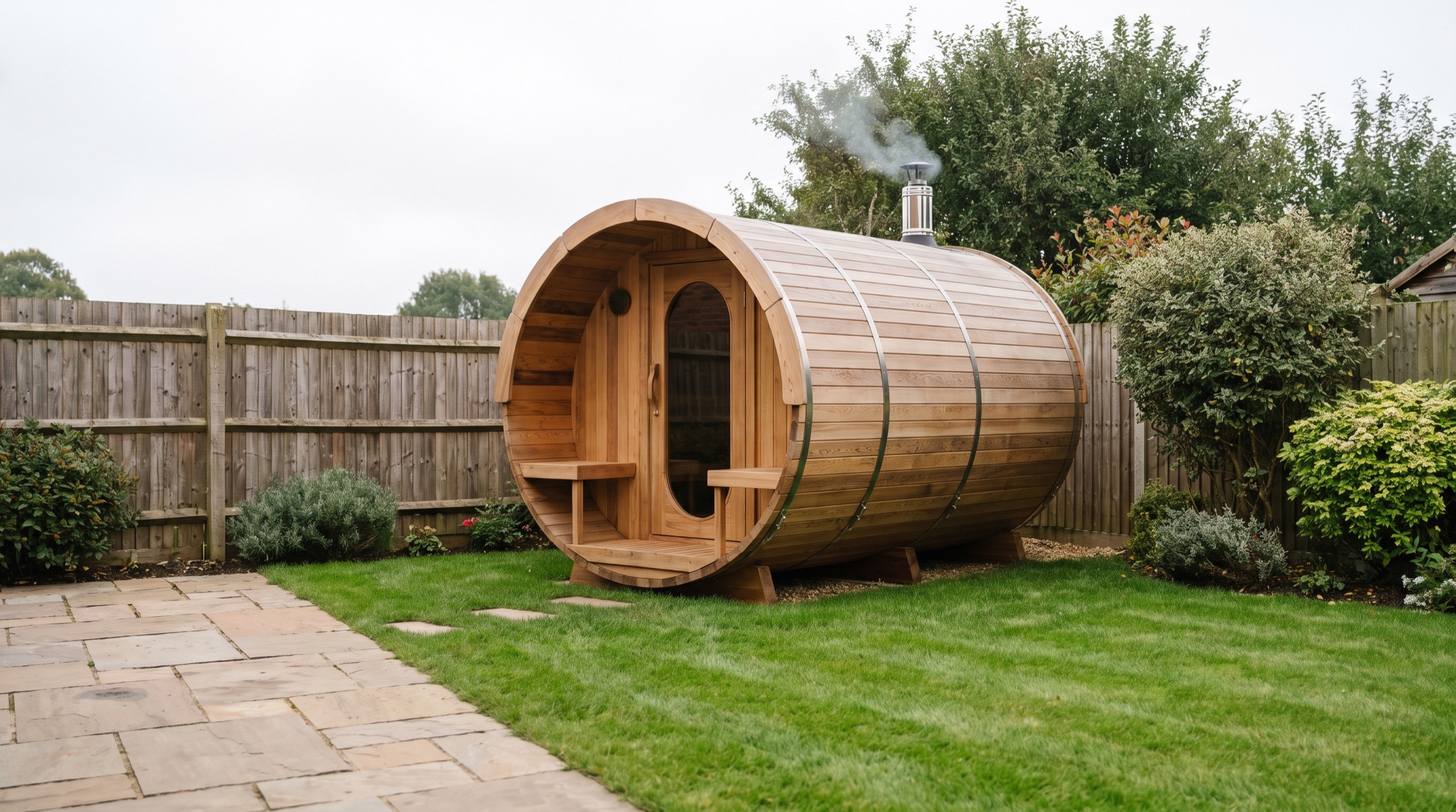
For an outdoor sauna in a typical British garden, expect £4,500–£12,000 installed. Most of that range is the cabin itself; £600–£1,400 covers base prep and a 32A electrical circuit run from your consumer unit. Most outdoor saunas don’t need planning permission — see our UK planning permission guide for the full position.
For an indoor home sauna, the range is wider — £3,000 to £15,000 — depending on whether you’re dropping in a pre-built freestanding cabin or building one into a bathroom or basement (our indoor home saunas guide covers this in detail). Indoor saunas need proper ventilation (a low intake and a high exhaust, vented to outside not to a loft void) and a vapour barrier behind the cabin walls. Done right, this isn’t a major job. Done badly, it creates damp problems two years later.
Steam room installation in the UK
Steam rooms need: a fully waterproofed enclosure with sealed glass-to-frame joints, a properly sized steam generator (typically wall-mounted in an adjacent service space, not inside the steam room itself), drainage, a tile or stone floor on a tanked screed, and a mechanical extractor vented to outside.
For a built-in bathroom steam room you’re looking at £4,000–£10,000 for the steam side, on top of whatever the surrounding bathroom refit costs. Standalone steam rooms in UK gardens are vanishingly rare. We’ve found one or two specialist suppliers who’ll do it, but the call-back rate on seal failures in British winters is significant. Most UK builders won’t quote.
So in practice, sauna goes outside or indoors; steam room is an indoor bathroom-integrated product. That’s the geometry that decides this for almost everyone.
UK running costs in 2026
At a UK electricity rate around 30p per kWh (May 2026), here’s roughly what each appliance costs to run per session.
| Appliance | Heater | Session | Cost per session |
|---|---|---|---|
| Sauna (6kW electric, outdoor barrel) | 30 min warm-up + 60 min cycling | 1 hour | ~£1.40 |
| Sauna (6kW electric, indoor cabin) | 20 min warm-up + 60 min cycling | 1 hour | ~£1.20 |
| Steam room (4kW generator) | 10 min warm-up + 20 min run | 30 mins | ~£0.60–0.80 |
| Steam room (6kW generator) | 10 min warm-up + 30 min run | 40 mins | ~£0.90–1.20 |
| Infrared cabin (1.6kW) | 10 min warm-up + 45 min run | 1 hour | ~£0.30–0.50 |
Steam rooms look cheaper per session in this table — but most steam-room owners use them more frequently than sauna owners (shorter sessions, more of them) so the annualised difference often shrinks. Three sauna sessions a week comes out around £18–20 a month. Five steam sessions a week comes out around the same.
If running costs are a deciding factor either way, you’re either solving the wrong problem or you should be looking at an infrared cabin — the lowest-cost option of the three by a clear margin.
Maintenance and longevity
A well-built outdoor sauna lasts 15–25 years with light annual maintenance (re-tension the bands on a barrel, oil cedar if you want to hold the warm tone, sweep a wood-fired flue, replace fractured rocks every couple of years). The heater is usually the first thing to fail at 8–12 years; budget around £600–£1,500 to replace it.
Steam rooms are less forgiving. The weak point is the seal between the glass and the frame — the temperature and humidity cycling slowly degrades the silicone, and a failed seal lets moisture into the wall structure behind. Most steam-room enclosures need a partial reseal at 5–8 years and may need a more substantial refurb at 10–12. The generator itself usually lasts 8–15 years. Budget realistically for ongoing maintenance — we’ve spoken to owners who didn’t, and the wall behind the steam room is now a building project.
So which is right for you?
The decision usually comes down to where you’d put it and what you’re optimising for. A few common UK situations:
- You want a sauna or steam room in the garden. Sauna. Steam rooms in UK gardens aren’t really a thing for good reason.
- You’re motivated by the cardiovascular evidence. Sauna. The research base is much stronger.
- You have chronic respiratory symptoms (sinus, mild asthma, frequent winter colds). Steam room has the edge here — but talk to your GP before you build one around the diagnosis.
- You’re refitting a bathroom and a steam shower would be a natural part of the work. Steam, almost certainly. This is the situation steam rooms were designed for.
- You want it to be sociable and used by guests, family, friends. Sauna. Multi-person sauna sessions are an established cultural thing; steam rooms are mostly solo.
- You’re nervous about the install scope. Sauna. Anything outdoor is simpler still.
Can you have both?
Yes, but it’s rare and we don’t usually recommend it. The cost roughly doubles, the maintenance load is much higher, and most owners we’ve spoken to end up using one of them far more than the other after the novelty wears off. If you’re determined, the practical configuration is an outdoor sauna in the garden plus a built-in steam shower in a master bathroom — different rooms, different use cases, no compromise on either.
About the steam-shower question
Coming back to the editorial note at the top of this article: a lot of readers asking us about steam rooms are really asking whether they can add some steam to an existing bathroom. The honest answer for most homes is: not really, but you can get part of the way there with a steam shower head, an upgraded extractor, and decent shower discipline. A proper steam room needs a fully sealed enclosure and a separate generator. A bathroom shower with the door closed and a hot water blast for ten minutes is not the same thing — but it’s also a £20 problem rather than a £6,000 one.
Frequently asked questions
Which is hotter, a sauna or a steam room?
A sauna. Sauna cabins typically run at 70–90°C; steam rooms at 40–50°C. The perceived intensity can be similar because the steam room’s 100% humidity stops sweat from cooling you — but on a thermometer, the sauna is dramatically hotter.
Is a steam room better for blocked sinuses than a sauna?
Yes, generally. Humid heat thins mucus and eases congestion; dry sauna heat doesn’t have the same effect and can sometimes feel drying. That said, both will give you some short-term relief from a stuffy nose — a kettle and a tea towel will do the same for free.
Can you sweat more in a steam room or a sauna?
In a sauna. Higher core temperatures drive heavier sweating. In a steam room you stay covered in condensation, which feels like a lot of sweat — but most of the moisture on your skin is actually water from the room, not from you.
Are saunas or steam rooms better for weight loss?
Neither, really. You’ll lose water weight in a session, which comes straight back on the next glass of water. Long-term weight effects are small, marginal, and dwarfed by diet and exercise. If you see a sauna or steam room marketed for weight loss, treat that as a warning sign about the rest of the marketing.
Are saunas or steam rooms safe during pregnancy?
Ask your midwife, and treat both cautiously in the first trimester. Hyperthermia in early pregnancy is associated with roughly double the risk of neural tube defects, so the caution is well founded. The reassuring part: a 2019 systematic review found 20 minutes in a 70°C sauna, or a 40°C bath, left core temperature well below the 39.0°C threshold. Steam rooms were not covered by that review, and they are the harder case, because saturated air stops sweat evaporating so heat builds faster at a lower air temperature. The NHS no longer publishes sauna or steam room guidance for pregnancy, but it does list pregnancy among the groups most vulnerable to heat.
The bottom line
For nearly every UK household, the sauna is the better answer. The evidence is stronger, the installation is simpler, the maintenance load is lower, and the building doesn’t fight you. The steam room is the right answer in a narrow but real set of circumstances — particularly if you’re already refitting a bathroom and a sealed steam shower is part of the brief.
If you’ve decided on a sauna and want help choosing the type, our outdoor saunas guide covers the popular UK options. If you’d rather skip straight to talking to someone who’ll install it, browse our directory of vetted UK sauna builders — filter by region, send an enquiry, and you’ll typically hear back within 1–3 working days.
Still weighing it up? Browse our other sauna comparisons for more UK head-to-heads.
Reviewed by the SaunaCentral editorial team. Have a question we haven’t answered? Write to us. We read everything.
Looking for a sauna recommendation?
Tell us your space, budget, and preferences. We’ll match you with the perfect sauna from our curated selection.