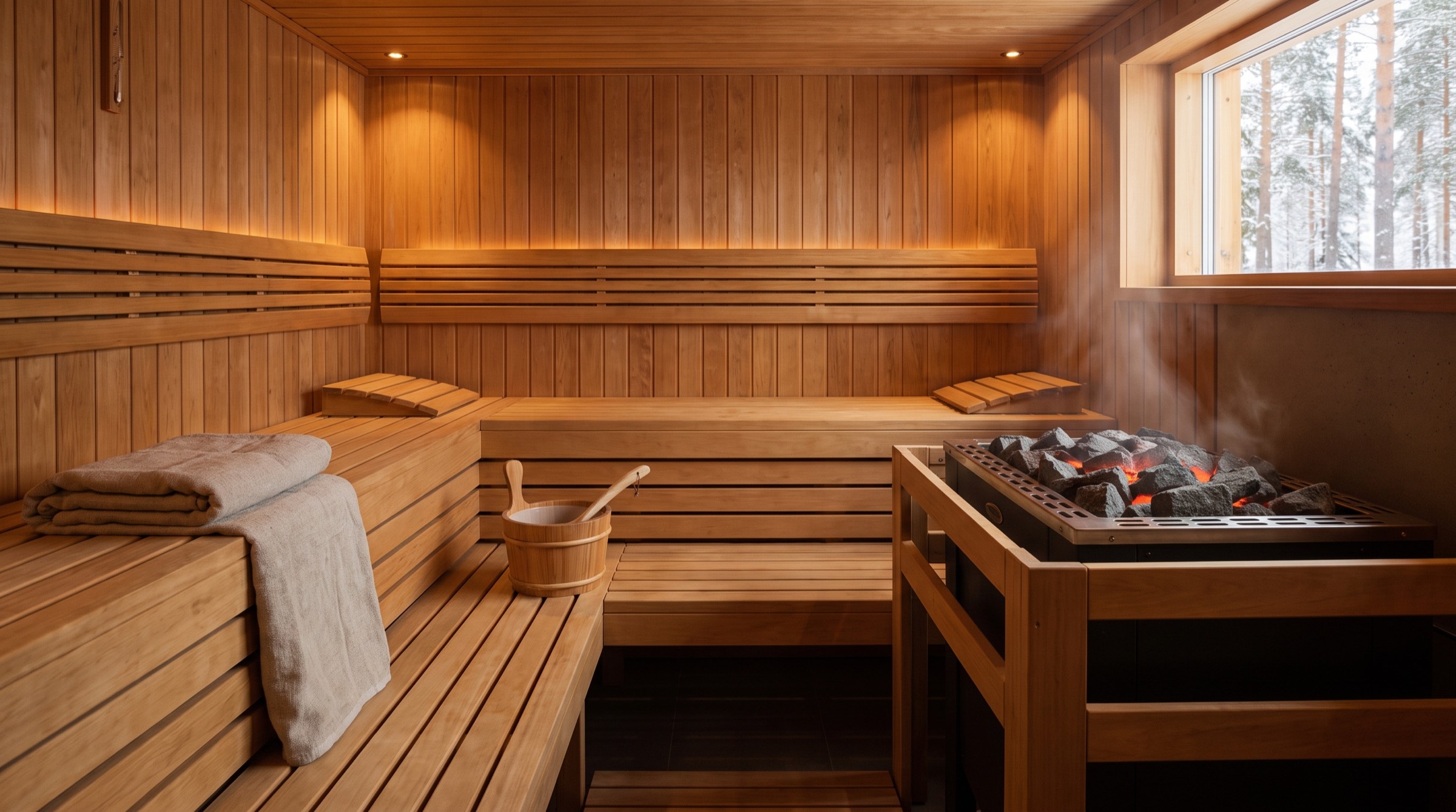
Sauna culture has spread well beyond Finland. Across the UK you’ll find barrel saunas in suburban gardens, infrared cabins tucked into spare rooms, and entire wellness sites built around heat. Most of the marketing comes loaded with claims — improved immunity, better skin, accelerated weight loss, accelerated anything. Some of it is real. Some of it isn’t.
This guide separates the two. We’ve gone through the strongest peer-reviewed evidence, prioritised long-running cohort studies and recent systematic reviews, and stuck to what’s actually defensible. Where the science is genuinely strong (cardiovascular health, in particular), we say so. Where it’s marketing dressed up as research (detoxification, weight loss), we say that too.
Eight benefit areas come up repeatedly. We’ll work through them in roughly the order of evidence quality — strongest first.
Sauna benefits at a glance
| Benefit | Strength of evidence | The honest take |
|---|---|---|
| Cardiovascular health | Strong | 20-year cohort data; the best reason to use a sauna |
| Stress & sleep | Moderate | Consistent direction, smaller studies |
| Muscle recovery | Moderate | Real but modest; use after training, not before |
| Brain & cognitive health | Promising, early | Striking dementia data, but observational |
| Immune function | Weak | Possible, but underpowered evidence |
| Skin | Modest | Genuine but small effect |
| Detoxification | None | Marketing, not science |
| Weight loss | None | Water weight only; it comes straight back |
| Longevity (heat shock proteins) | Speculative | Mostly animal and mechanistic work |
Each benefit is unpacked below.
Cardiovascular health — the strongest evidence
If you only read one section, read this one. The cardiovascular evidence for regular sauna use is the most robust we have, and it’s been built up over decades.
The landmark study is the Finnish KIHD (Kuopio Ischaemic Heart Disease) cohort, published in JAMA Internal Medicine in 2015. Researchers tracked 2,315 middle-aged Finnish men for a median of 20 years and looked at how often they used a sauna. The findings were striking: men who used a sauna 4–7 times per week had a 50% lower risk of fatal cardiovascular events than men who used one once a week. All-cause mortality was also significantly reduced, and the relationship was dose-dependent — more sauna use meant lower risk, up to a point.
That’s an observational study, so it can’t prove causation on its own. But the mechanism is well understood. A sauna session at 80–100°C raises heart rate to 120–150 beats per minute — comparable to moderate-intensity exercise. Blood vessels dilate. Endothelial function improves. Repeated heat exposure appears to do for the cardiovascular system what regular brisk walking does, with substantial overlap in the physiological response.
A 2018 review in Mayo Clinic Proceedings pulled together the wider evidence base and concluded that regular sauna bathing is associated with reduced risk of cardiovascular disease, hypertension, and stroke. The effect sizes are not small. They’re roughly in the same ballpark as you’d expect from a structured exercise programme.
For UK readers: the typical research dose is 4–7 sessions per week of 15–30 minutes at 80–100°C. That’s a lot. Realistically, 2–3 sessions per week is more achievable for most people, and it still appears to offer meaningful benefit — the data suggests benefits scale with frequency rather than requiring a specific minimum.

Stress, sleep, and mental wellbeing
The cardiovascular evidence is rigorous. The mental wellbeing evidence is more modest, but the direction is consistent.
A sauna session triggers a parasympathetic (“rest and digest”) response in the period afterwards. Cortisol rises during the heat exposure itself but drops below baseline in the hours that follow. Heart rate variability, often used as a marker of stress recovery, tends to improve. Several small studies report better self-reported sleep quality after evening sauna sessions, particularly when combined with a cool-down period before bed.
What’s less clear is whether saunas treat clinical anxiety or depression. There’s some preliminary work, but the effect sizes are modest and the studies are small. Treat this as small-study territory: interesting, worth watching, not yet clinical evidence.
What you can say with reasonable confidence: regular sauna use is unlikely to harm your mental wellbeing and may help with sleep and acute stress recovery. That’s enough for most people to find it worthwhile.
Muscle recovery and pain relief
If you exercise, the case for post-training sauna use is reasonable. Studies of athletes have shown improvements in subjective recovery, reduced delayed-onset muscle soreness, and faster return-to-baseline of certain inflammatory markers after intense sessions. Most of the research uses Finnish-style saunas at 80–90°C for 15–20 minutes, ideally taken 30–60 minutes after the workout rather than immediately.
A note on timing: sauna before training is a different matter and generally not recommended. Pre-exercise heat exposure can blunt strength performance and increase cardiovascular strain. If you’re using the sauna for recovery, use it after — and rehydrate properly.
For chronic pain conditions, the evidence is mixed. There’s some support for sauna use easing rheumatoid arthritis and ankylosing spondylitis symptoms, mainly from small Finnish studies. It’s a supportive therapy, not a treatment — useful alongside medical care, not as a replacement.
Brain health and cognitive function
This is the section that gets the most attention in popular health writing, and it’s worth being careful about.
A 2017 follow-up to the Finnish KIHD cohort, published in Age and Ageing, looked at sauna frequency and dementia risk. Men who used a sauna 4–7 times per week had a 65% lower risk of being diagnosed with Alzheimer’s disease over 20 years compared with once-a-week users. The headline number is dramatic, and it has been quoted everywhere.
The caveats matter. This is a single observational cohort in a Finnish population where sauna use is culturally embedded. Confounders are difficult to fully control for: people who use saunas frequently may also be more socially active, more affluent, or have other lifestyle factors that protect against dementia. The mechanism is plausible — improved cardiovascular health is itself a known dementia risk modifier, and heat shock proteins may play a role in clearing misfolded proteins associated with neurodegenerative disease — but plausible isn’t proven.
What’s reasonable to conclude: regular sauna use looks promising for long-term brain health, the mechanism is biologically sensible, and there’s no signal of harm. It’s not a treatment for cognitive decline, and we’d be wary of anyone who tells you it is.
Immune function
You’ll see claims that saunas boost immunity. The evidence is genuinely thin.
A small 1990 Austrian study reported fewer common cold episodes in regular sauna users versus controls over six months. A handful of mechanistic studies have shown short-term changes in white blood cell counts after a sauna session. Beyond that, the literature is sparse and often poorly controlled. In short: there might be a modest effect on respiratory infection frequency. We’d file this as possible but underpowered evidence, not as a primary reason to invest in a sauna.
Skin, “detoxification,” and weight loss — the honest take
This is where most of the marketing claims live, and most of them don’t survive scrutiny.
Detoxification. Sweat is roughly 99% water and electrolytes. Trace amounts of metals and some lipid-soluble compounds do appear in sweat, but in concentrations vastly lower than what your liver and kidneys process daily. A 2011 review in Alternative Medicine Review is sometimes cited in support of sauna detox claims; the actual paper is much more measured than the marketing copy that quotes it. Your liver and kidneys do the detoxification. Your sweat glands do thermoregulation. They are not the same system.
Weight loss. A typical sauna session burns 100–200 calories — roughly equivalent to a 20-minute walk. Most of the weight you lose during the session is water, and you’ll regain it within a few hours of rehydrating. There’s no compelling evidence that sauna use produces meaningful fat loss. For the full picture, see our guide to whether a sauna is good for weight loss.
Skin. Here there is something to say. The combination of mild vasodilation, increased perfusion, and sweat-driven cleansing of pore surfaces does appear to improve skin barrier function and short-term appearance. It’s not transformative, but it’s real. Some dermatology research also suggests sauna use may reduce the frequency of certain inflammatory skin flares, though the studies are small.
The summary: skin yes (modestly), detox no, weight loss no.
Heat shock proteins and cellular repair
This is the most speculative section in this article, and we’ve kept it short on purpose.
Heat shock proteins (HSPs) are molecular chaperones that help cells refold misfolded proteins, manage oxidative stress, and respond to heat. Sauna exposure reliably increases HSP expression. In animal studies and some early human work, this has been linked to improved cellular resilience, reduced muscle atrophy, and possibly longevity-related pathways.
Most of this remains animal-model and mechanistic work. It’s plausible that frequent heat exposure provides longevity benefits via HSP pathways, but the human evidence is preliminary. Don’t invest in a sauna for the heat shock proteins specifically — invest for the cardiovascular evidence and treat HSP benefits as a possible bonus.
How often, how long, and how hot for actual benefits?
The evidence base mostly comes from Finnish studies of traditional dry saunas, so the dose-response data is most reliable for that style. Synthesising across the literature:
- Frequency: 2 sessions per week is a reasonable starting point. 3–4 sessions per week is where the cardiovascular benefit becomes consistent across studies. 4–7 sessions per week is where the strongest mortality reductions appear, but it’s a lot of life to dedicate to a sauna.
- Duration: 15–30 minutes per session at sauna-room temperature. Less if you’re new to it. Build tolerance gradually.
- Temperature: 80–100°C for traditional saunas. Infrared saunas operate cooler (50–65°C) and the dose-response data there is less developed.
- Hydration: drink water before and after. A rough rule is 500ml of fluid for every 30 minutes of sauna time.
For more on getting session length right, see our guide to how long you should stay in a sauna.
Who should NOT use a sauna?
This section is short on purpose. If any of the following apply, get medical advice before regular sauna use:
- Pregnancy. Talk to your midwife first. Hyperthermia in early pregnancy is associated with roughly double the risk of neural tube defects (meta-analysis of 15 studies, odds ratio 1.92). That said, a 2019 systematic review found 20 minutes in a 70°C sauna left core temperature at 37.6°C, well under the 39.0°C threshold thought to carry risk. Most UK home saunas run hotter than 70°C, so keep any session short and cooler, or skip it while pregnant.
- Uncontrolled high blood pressure. Sauna use causes blood pressure changes that may not be safe if your hypertension isn’t well managed.
- Recent cardiovascular event. Anyone within 3 months of a heart attack, stroke, or significant cardiac procedure should not use a sauna without explicit clearance from a cardiologist.
- Certain medications. Some blood pressure medications, diuretics, and stimulants don’t combine well with the cardiovascular load of a sauna session. Check with your prescriber.
- Active illness with fever. A sauna session adds heat stress your body is already dealing with. Wait until you’ve recovered.
For everyone else, sauna use is generally well tolerated. The main risks are dehydration, overheating, and falls related to dizziness on standing — all manageable with sensible behaviour.
Do infrared saunas deliver the same benefits?
Most of the research is on Finnish-style saunas. Infrared saunas operate at lower air temperatures (50–65°C versus 80–100°C) but achieve a similar core temperature rise via direct radiant heating of the skin and body tissues. The evidence base for infrared is smaller, but the cardiovascular and recovery findings appear broadly comparable. Where the studies diverge is in the depth of evidence: there are decades of Finnish cohort data; there are years of infrared trials.
For most of the benefits in this article, either type works. For the strongest evidence specifically, traditional Finnish-style is what the literature is built on. For more on how the two compare, see our infrared saunas guide.
Frequently asked questions
Do saunas actually reduce the risk of heart disease?
This is the strongest claim in the whole field, though the evidence is observational rather than causal. In the Finnish KIHD cohort published in JAMA Internal Medicine in 2015, men who used a sauna 4–7 times per week had a 50% lower risk of fatal cardiovascular events than men who used one once a week, and all-cause mortality was significantly lower too. A 2018 review in Mayo Clinic Proceedings linked regular sauna bathing to reduced risk of cardiovascular disease, hypertension and stroke. The mechanism is well understood: a session at 80–100°C raises heart rate to 120–150 beats per minute, comparable to moderate-intensity exercise.
How often should I use a sauna to see health benefits?
The dose-response data suggests 2–3 sessions per week is the practical minimum to see consistent cardiovascular benefits, with 4+ sessions per week associated with the strongest effect sizes in long-term studies. For mental wellbeing and recovery benefits, even 1–2 sessions per week appears to help.
Are saunas safe if I have high blood pressure?
If your hypertension is well controlled, regular sauna use is generally considered safe and may help lower blood pressure over time. If your blood pressure is uncontrolled or you’re on medications that affect cardiovascular response, talk to your GP first. Saunas are not safe immediately after a recent cardiovascular event.
Can saunas help with weight loss?
Not in any meaningful way. The weight you lose during a session is water, and you’ll regain it once you rehydrate. A sauna session burns roughly 100–200 calories, comparable to a 20-minute walk. If you’re focused on body composition, saunas are a poor primary tool but a reasonable supportive habit.
Are infrared saunas as healthy as traditional saunas?
The mechanisms are different — infrared heats your body directly, traditional saunas heat the air around you — but the physiological effects are broadly similar at appropriate doses. The strongest research base is on traditional Finnish-style saunas. Infrared evidence is growing and largely consistent, but smaller in scale.
Can I use a sauna while pregnant?
The honest answer: more reassuring than most advice suggests, but with limits. Hyperthermia in early pregnancy is associated with about double the risk of neural tube defects, so the concern is real. But a 2019 systematic review of 347 pregnant women found none exceeded the 39.0°C teratogenic threshold, and sauna exposure produced a mean core temperature of just 37.6°C. The catch is that the studied conditions were 70°C for 20 minutes, and most UK home saunas run at 80–100°C. The NHS no longer publishes sauna-specific pregnancy guidance, though it does list pregnancy among the groups most vulnerable to heat. Talk to your midwife, keep sessions short and cooler than usual, and get out if you feel faint.
The bottom line
Regular sauna use is one of the better-evidenced wellness habits available. The cardiovascular benefits are real and substantial. Recovery and stress benefits are genuine, if more modest. Brain health evidence is promising but newer. Detox and weight-loss claims are mostly hype.
If you’re considering a sauna for your home for the health reasons, the evidence supports the decision. The next question is which type, what size, and where it goes — start with our outdoor saunas and infrared saunas guides, or browse all our health & wellbeing guides. When you’re ready to talk to someone about installing one, we can also connect you with vetted UK installers near you.
This article was prepared by the Sauna Central editorial team. Last reviewed: May 2026. Studies cited are linked inline. Health information here is educational and is not a substitute for medical advice — speak to your GP about whether sauna use is appropriate for your specific circumstances.
Looking for a sauna recommendation?
Tell us your space, budget, and preferences. We’ll match you with the perfect sauna from our curated selection.